
Client
Major offshore operator (North Sea)
Location
Offshore accommodation vessel / platform
Scope
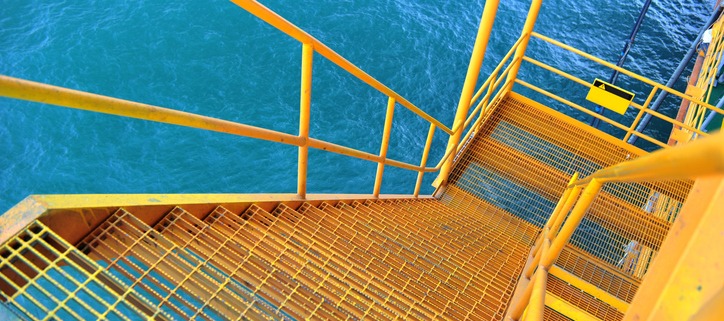
Waterbag load test on accommodation ladder and winch system
- Test load: 1.8 tonnes applied via calibrated waterbags
Background
Safe and reliable personnel access is critical in offshore operations. Accommodation ladders are often in constant use – transferring crew and visitors between vessels and offshore installations – and must perform flawlessly in harsh marine environments.
Our offshore client required a statutory proof load test on one of their accommodation ladders to verify the integrity of both the ladder structure and the associated winch brake system. With safety, compliance and minimum disruption to operations as key priorities, they turned to Lift-Rite Engineering Services.
The Challenge
The client needed to:
- Confirm that the accommodation ladder could safely sustain its rated working load plus an appropriate safety margin.
- Verify the structural performance of the ladder, including key connection points and supporting framework.
- Demonstrate the holding capability of the winch brake, ensuring it could safely retain the applied load without creep or slippage.
- Complete the testing within a tight operational window, with minimal impact on normal marine and deck activities.
Any test solution had to be accurate, controllable and easily deployed offshore, while providing clear evidence for the client’s internal safety and compliance records.
Our Solution
Lift-Rite Engineering Services proposed a waterbag load test – a proven, flexible approach ideally suited to offshore lifting and access equipment. Waterbags allow the test load to be applied smoothly and incrementally, giving our engineers and the client’s team full control throughout the process.
Planning & Preparation
Our team began with a review of:
- The accommodation ladder drawings and OEM data.
- Existing inspection reports and certification.
- Site conditions and available rigging points.
Using this information, we developed a test plan detailing:
- Target test load of 1.8 tonnes.
- Waterbag configuration and rigging arrangement.
- Load application steps and hold periods.
- Inspection points and acceptance criteria.
All activities were planned to comply with relevant offshore and lifting regulations, as well as the client’s own procedures.
Test Execution
- Site Setup
On arrival offshore, Lift-Rite technicians:
- Inspected the accommodation ladder and surrounding structure.
- Confirmed suitable anchorage and rigging points for the waterbags and load cells.
- Set up calibrated load monitoring equipment to record applied loads throughout the test.
Safety controls, exclusion zones and communication protocols were agreed with the client’s on-board team before the load test commenced.
- Load Application
Using our calibrated waterbag system, the test load was applied in controlled increments up to 1.8 tonnes.
At each stage, the team:
- Monitored load readings in real time.
- Checked for any signs of structural deformation, movement or abnormal noise.
- Verified that the winch brake was holding the load effectively, with no evidence of slippage.
Once the full 1.8t test load was achieved, it was held for an agreed period to simulate operational conditions and allow a thorough visual inspection.
- Post-Test Inspection
After carefully releasing and draining the waterbags, our engineers:
- Re-inspected the ladder structure, welds, fixings and key connection points.
- Checked the winch and brake system for any signs of distress or damage.
- Confirmed that there was no permanent deformation or change in performance.
Results
The waterbag test successfully:
- Demonstrated the accommodation ladder’s ability to sustain a 1.8t load without structural issues.
- Confirmed the winch brake’s holding capability under the applied load.
- Provided the client with clear, auditable evidence that the access system remains fit for purpose.
All findings, load data and observations were collated into a comprehensive test report, including:
- Test configuration and methodology.
- Photographic evidence.
- Engineer’s comments and recommendations.
This documentation now forms part of the client’s ongoing inspection and certification record, supporting both internal assurance and regulatory compliance.
Added Value for the Client
Beyond simply “passing” a test, the client benefited from:
- Minimal disruption – the waterbag test was planned and executed around operational requirements, keeping downtime to a minimum.
- Expert offshore support – Lift-Rite’s team are experienced in working in live marine environments, coordinating safely with vessel and platform crews.
- Confidence in critical access equipment – the client’s HSE and marine teams now have robust, current evidence underpinning continued use of the ladder.
Conclusion
This project is a clear example of how Lift-Rite Engineering Services supports offshore operators with practical, compliant and reliable testing solutions.
By combining waterbag technology with specialist lifting and inspection expertise, we help clients verify the integrity of their critical access and lifting equipment – before issues arise, not after.
Need Proof Load Testing Offshore?
Whether you require load testing for accommodation ladders, davits, cranes, lifting frames or access systems, Lift-Rite can provide:
- Onshore and offshore waterbag load testing
- Design and supply of bespoke test rigs and cradles
- Comprehensive inspection and reporting
To discuss your next project:
Phone: +44 (0)191 234 3366
- Email: sales@lift-rite.com
We’ll work with you to design a test programme that keeps your people safe, your assets compliant and your operations running.


